Turbofan Laser Cleaning
SPARCL is dedicated to revolutionizing industrial laser technology with advanced robotic solutions that enhance precision cleaning, welding, and marking — streamlining operations across aerospace and industrial environments.
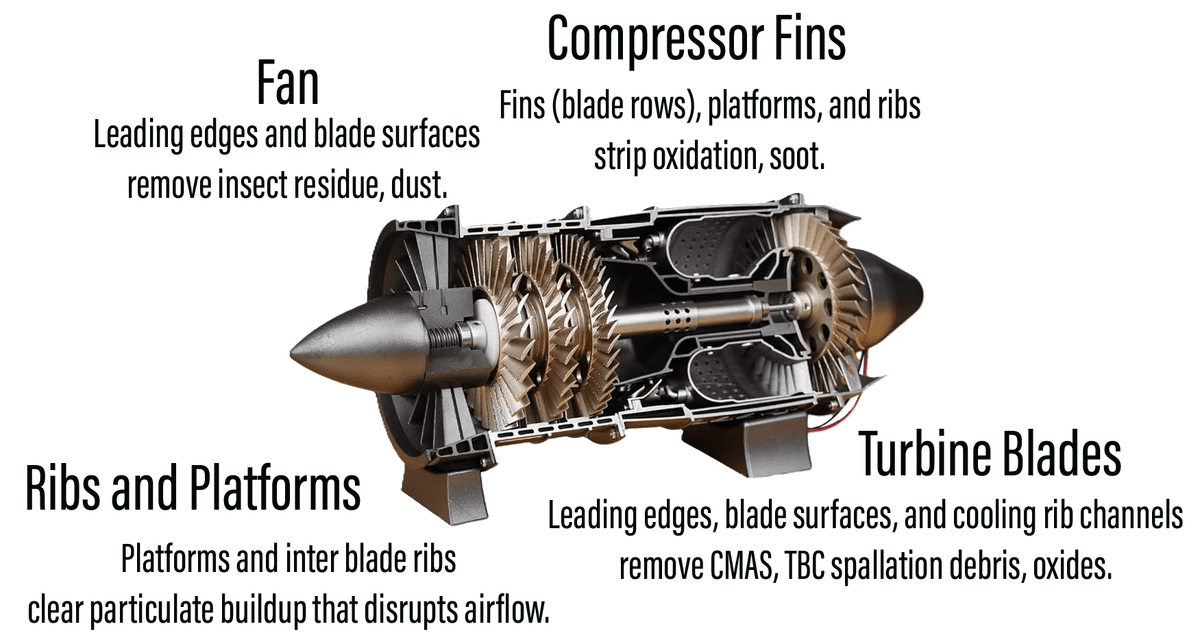
Principles of Laser Cleaning
Laser cleaning uses focused laser pulses to remove contaminants — soot, oxides, CMAS (CaO-MgO-Al₂O₃-SiO₂), and grease — from turbine engine components without abrasive media or chemicals.
Photothermal / Photomechanical Ablation
High-peak-power pulses (10-100 ns) induce rapid thermal expansion and shockwaves, spalling off deposits while preserving the substrate.
Two coupled mechanisms — instant thermal expansion plus an acoustic shockwave — lift contaminants without dumping bulk heat into the substrate.
Wavelength Selectivity
Near-infrared (1064 nm) Nd:YAG fibers exploit stronger absorption by contaminants versus metal, maximizing cleaning efficiency.
Nickel superalloys reflect ~70% of 1064 nm light; CMAS, soot, and oxide layers absorb >90%. The contaminant burns; the blade barely warms.
Assist Gas Purging
Argon or nitrogen flows (1-5 bar) purge ablated debris and inhibit re-oxidation during cleaning, ensuring pristine surface finish.
An inert curtain over the work zone evacuates the ablation plume in microseconds and starves any re-oxidation of fresh metal exposed by the laser.
Research on Turbine Blade Cleaning
High-Pressure Turbine (HPT) Blades
Studies on nickel-based superalloy blades coated with Y₂O₃-stabilized ZrO₂ show that continuous-wave fiber lasers (power density ≈ 7.96 × 10⁶ W/cm²) effectively remove CMAS deposits under argon, delivering clean surfaces with controlled roughness.
Integration of pulsed and continuous modes further improves oxide removal quality and throughput, enabling faster turnaround on critical hot-section components.
Compressor & Fan Blades
Surface fouling on compressor stages degrades aerodynamics; laser ablation can strip oxide scales and debris without altering blade geometry. Early work demonstrated no microstructural damage when parameters are optimized, confirmed via SEM and X-ray analyses.
This makes laser cleaning ideal for routine compressor maintenance where preserving aerodynamic profiles is critical to engine performance and fuel efficiency.
Laser-Cleaning Sequence for Automation
A robotic arm equipped with adjustable-focus fiber-laser delivery automates precise cleaning of each turbofan component — minimizing human intervention while ensuring repeatable coverage.
Pre-Inspection & Fixturing
- Machine-vision scans to map blade geometry and locate ribs/platforms
- Position robotic arm(s) with appropriate beam path
- 3D surface profiling establishes baseline roughness measurements

Rib & Platform Cleaning
- Focused scan pattern traverses narrow rib channels first, eliminating debris that could shadow blades
- Moderate overlap with lower pulse energy to avoid nicking edges
- Real-time feedback adjusts beam intensity based on surface reflectivity

Compressor Fins & Fan Blades
- Beam sweeps along blade spans, starting on the hub side and moving outward
- Higher repetition rates with continuous scanning for uniform coverage
- Automated path planning ensures complete coverage of complex geometries

Turbine Blade Cleaning
- Assist-gas purge (argon) captures high-temperature oxides and CMAS
- Multi-pass strategy: first pass at lower power for photochemical ablation of organics, second pass at higher power for oxide spallation
- TBC integrity monitoring ensures no thermal barrier coating damage

Final Inspection & Validation
- Post-cleaning borescope and 3D laser profilometry verify surface roughness
- Automated comparison against baseline measurements confirms no TBC or substrate damage
- Feedback loop adjusts parameters for next part in the batch

Why Robotic Laser Cleaning
Zero Substrate Damage
Preserves blade geometry, TBC coatings, and microstructural integrity throughout the cleaning process.
Full Automation
Robotic arm with machine vision eliminates manual intervention, delivering consistent results every time.
Faster Turnaround
Multi-pass laser strategies complete in minutes what chemical stripping and blasting take hours to achieve.
Environmentally Clean
No chemicals, no abrasive media, no hazardous waste streams. Just focused light energy.
Ready to automate turbofan maintenance?
SPARCL's robotic laser cleaning systems are engineered for MRO environments. Let's discuss your application.